


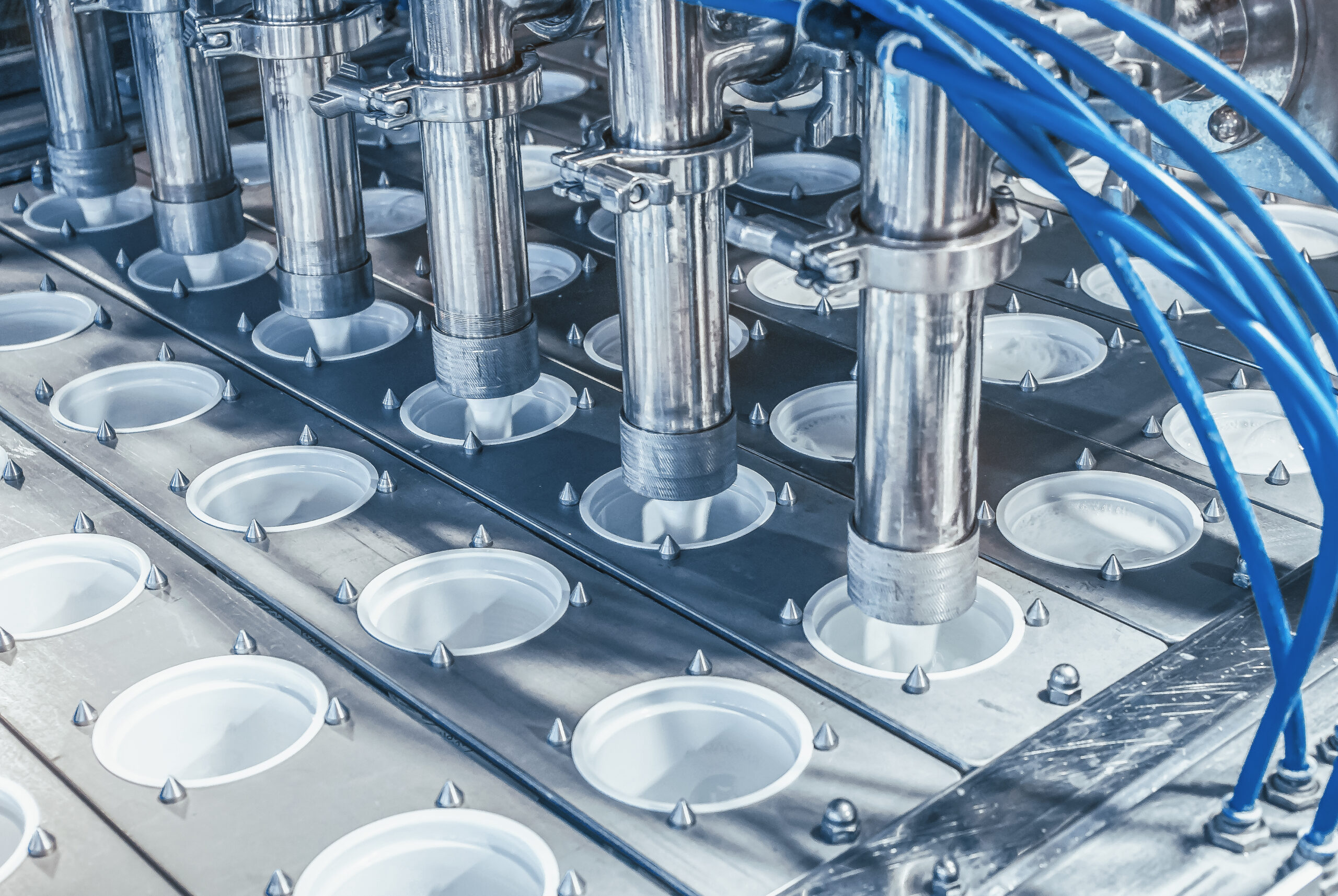
Greater efficiency in pudding production – How we’re automating and optimizing the manufacturing process for a true classic at our new facility.

It’s a true pudding classic on supermarket shelves. After the Müller Group acquired the Landliebe brand, pudding production was moved from the Heilbronn and Schefflenz sites to the existing Müller dairy in Leppersdorf. Shortly thereafter, we were commissioned to handle the process engineering design and reprogramming of the entire production line at the new location—with a clear focus on consistent quality and maximum batch scalability.

The challenge

Traditional pudding production, in particular, requires specific processes with regard to consistency and viscosity. These processes did not yet exist in this form at the Müller Group; accordingly, they had to be designed and brought up to the latest state of the art at the Heilbronn and Schefflenz sites in order to continue producing competitively.

The most important requirements for our programming:

Same product quality

Scaling production volume, maximum batch sizes

Extension of production cycles

Shortening cleaning breaks

Pudding production places enormous demands on automation within a strictly timed window: On the one hand, temperatures must be constantly monitored to prevent the product from burning. At the same time , cleaning performance must be optimally adjusted to meet the high hygiene standards for plant cleanliness in the shortest possible time.

“To keep a process sterile, all connection points or pipe ends must be flushed with steam or condensate. These areas can become very hot at times. If the product flow is not constant at these points, scorching occurs, which then manifests as black specks in the final product. In addition, the semolina pudding is very thick and sticky, which hinders a uniform flow. These two factors make the process very difficult to control and cleaning very labor-intensive.”

Jens FiebigProjektleiter

Solution

Comprehensive process automation

Site relocation and rollout in Just 6 Months

Thanks to our experience with similarly viscous products in the organic sector, we were able to design the pudding production line in a very short time and optimize the process in all areas. The basic process was also commissioned in just a few weeks—and full-scale production was launched just as quickly.
1

Stocktaking

2

Software analysis

3

Process design in collaboration with the plant manufacturer

4

Redefining the Interfaces

5

Reprogramming an existing manufacturing process to bring it up to state-of-the-art standards

6

Tests and simulations conducted throughout the process

7

Rapid commissioning of the core process

8

Scaling the process to full-scale production runs

01

Process engineering design

First, the software was analyzed in the existing system at a different location and incorporated into process specifications. Our partner then optimized the required hardware for the plant engineering and adapted it to a modern hygienic design. We jointly incorporated all changes into the process specifications. At the same time, we analyzed the interfaces with a UHT system for heating the pudding and the filling line. Both were new systems that required a redefinition of the interfaces.

02

Software development

In the next step, we developed the software for the processes. To do this, we first had to modify the software classes to implement the vapor barrier functionality. The goal here was to safeguard the system with sterile condensate and keep the heat input from steam as low as possible.

03

Adjustments related to modifications

During the development of the software, an additional mixing station was implemented to supply the raw product. The mixing function had to be coordinated with the motor speed controls in such a way that the semolina was mixed in homogeneously while introducing as little air as possible into the milk. To achieve optimal cleaning performance, the software optimized the pump controls to ensure maximum flow of the cleaning agent and to ensure that all parts of the system were thoroughly flushed through timed cycles.

04

Simulations and tests

To ensure the system’s functionality in conjunction with the UHT unit and the filler, several simulations and tests were conducted prior to commissioning. The customer and the equipment manufacturer had to verify these test reports and approve them for on-site commissioning.

05

Commissioning

First, the basic installation of the PLC and hardware was carried out on site, followed by a hardware check of each component of the system. At the same time, the visualization system was verified against the installed hardware. Only after the hardware check was successfully completed were media such as steam and water turned on so that the system’s functions could then be tested individually. The steam shut-offs, flow rates, and control behavior were also adjusted and optimized.
Once the UHT unit and the filler were completed, the system’s overall functionality was tested using water. This was a prerequisite for running the system with the actual product.
Flow diagram of an industrial plant with colored piping, tanks, and process monitoring readings.

Knowledge transfer and process optimization

Benefits for management and operational staff:

Precise analyses thanks to MES data

Temperatures, quantities, pressures, and flow rates are stored in the database and also retrieved by the customer’s production data acquisition team.

Shorter cleaning intervals

By optimizing the routing, optimizing the cycle time for maximum throughput, and increasing pump capacity using data-driven variable-frequency drives.

Increased production capacity

Larger supply of sterile water, higher component throughput, less downtime due to cleaning.

18

%
Increase in production per cycle

automation excellence

Stayed on schedule and increased output.

Procedural expertise:

In the past, we have carried out several projects in the organic sector using comparable products, since similar types of starch are used in the organic sector.

Fine-tuning the cleaning process

When scaling the process to the new plant size in Leppersdorf, problems arose—particularly during cleaning—due to the highly viscous products; however, these were quickly resolved through software optimizations, even under significant time pressure.

Expertise in temperature control

Over the course of several weeks, repeated tests were conducted with the product to optimize its mixing and flow properties. The temperatures were adjusted to prevent scorching.

Well-established processes

All structural modifications to the blending process were implemented efficiently and very quickly, both in terms of hardware and software. Thanks in part to the excellent collaboration with the plant manufacturer bawako, we were able to hand over the plant for production on schedule.

This project demonstrates more than ever that there is no standard procedure for automation in such a demanding dairy process. It requires a great deal of experience and expertise to respond quickly to changes and roll out the software meticulously from one location to another. In a very short time, we’ve modernized a traditional yet highly complex process and made it ready for the future. By the way, the pudding still tastes just as good.

Jens FiebigProjektleiter

Porträt eines freundlich lächelnden Mannes im weißen Hemd.

Get in touch with us