


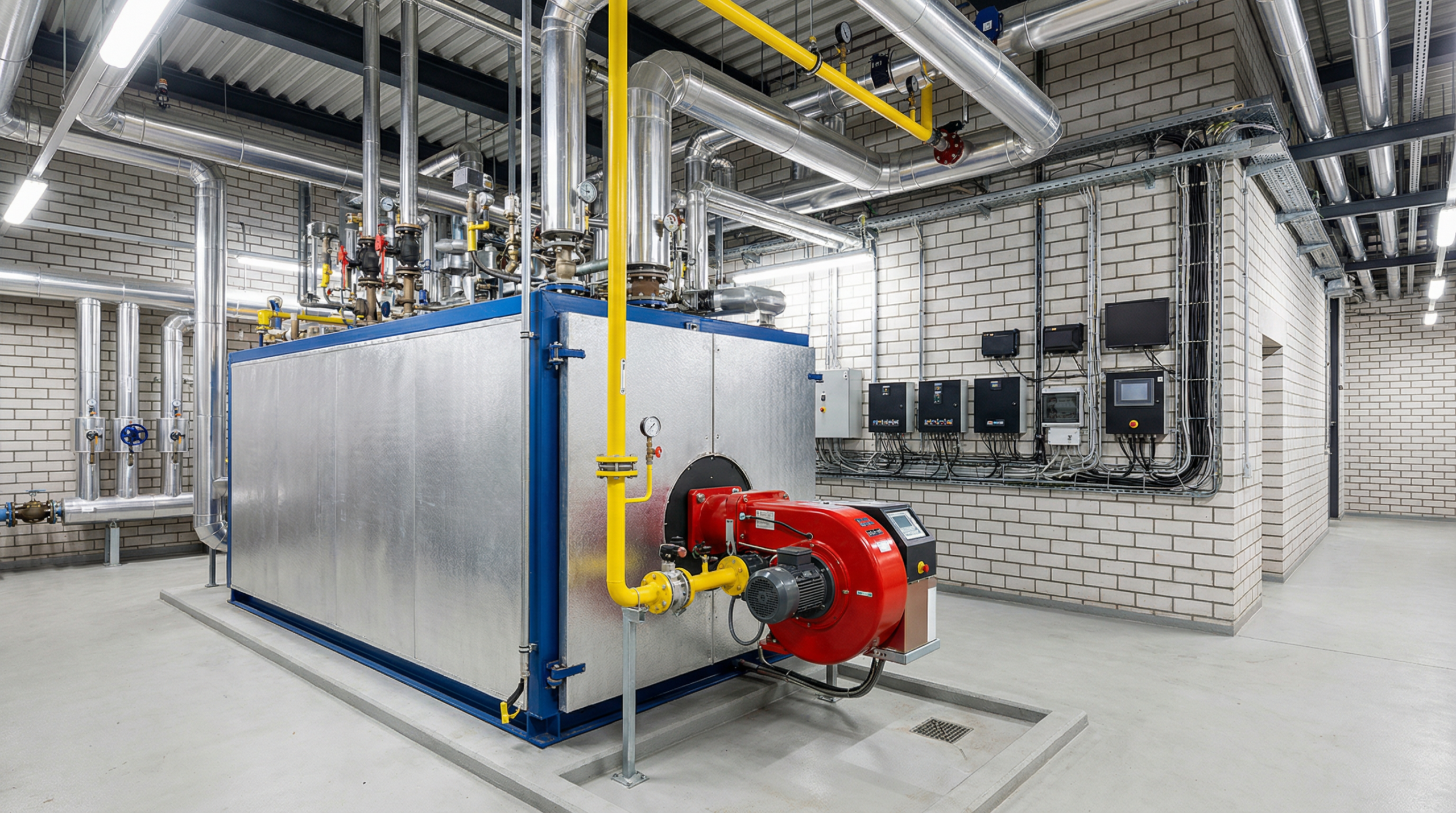
New weekly scheduler with no downtime—replacement of PCS7 with WinCC at the Löwenbrauerei Hall.
Outdated control systems and a boiler setup with room for improvement. Our long-standing client, Löwenbrauerei Hall, commissioned us to implement a weekly scheduler for a hot-water boiler. The goal was to make everything more transparent, more efficient, and easier for the operator to use. In less than two months, we updated the visualization and logic from the old Siemens PCS7 program to the latest version in WinCC V7.5.
0%
Downtime during modernization
Clear requirements for efficiency and clarity
Solution
The project focuses on the new weekly scheduler, which we implemented “on the fly” into an existing S7-300 controller. At the same time, the process view for the entire boiler area is being migrated from an old PCS7 environment and transferred to our existing WinCC project. To implement this, connections were established to two controllers operated by the boiler operators. These connections enable the transmission of operating modes (day, night, weekend) and temperature setpoints to the boiler, as well as the reception of data for the new visualization.
”"With our new WinCC interface, we're taking processes, usability, and PC security to a whole new level."
Keeping a close eye on what matters most
All required visualizations were created in WinCC. The new process screen allows users to set start and end times for night operations, as well as to define various parameters such as the start day, start time, end day, and end time for weekend operations. The corresponding setpoint temperatures are set via an integrated input window. In addition, the boilers and water piping in the relevant areas are visualized, and error messages and operating statuses are displayed in real time.
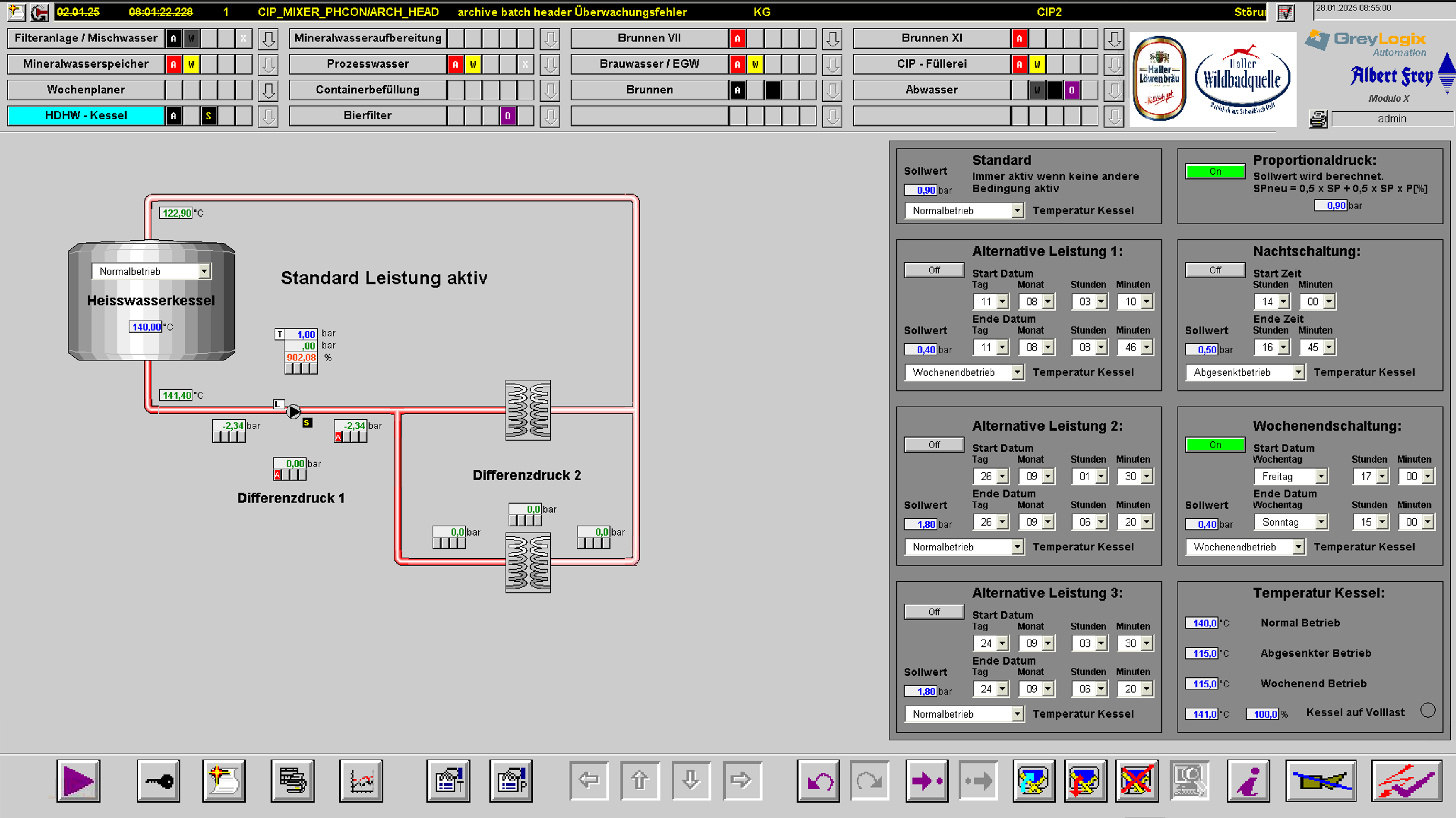
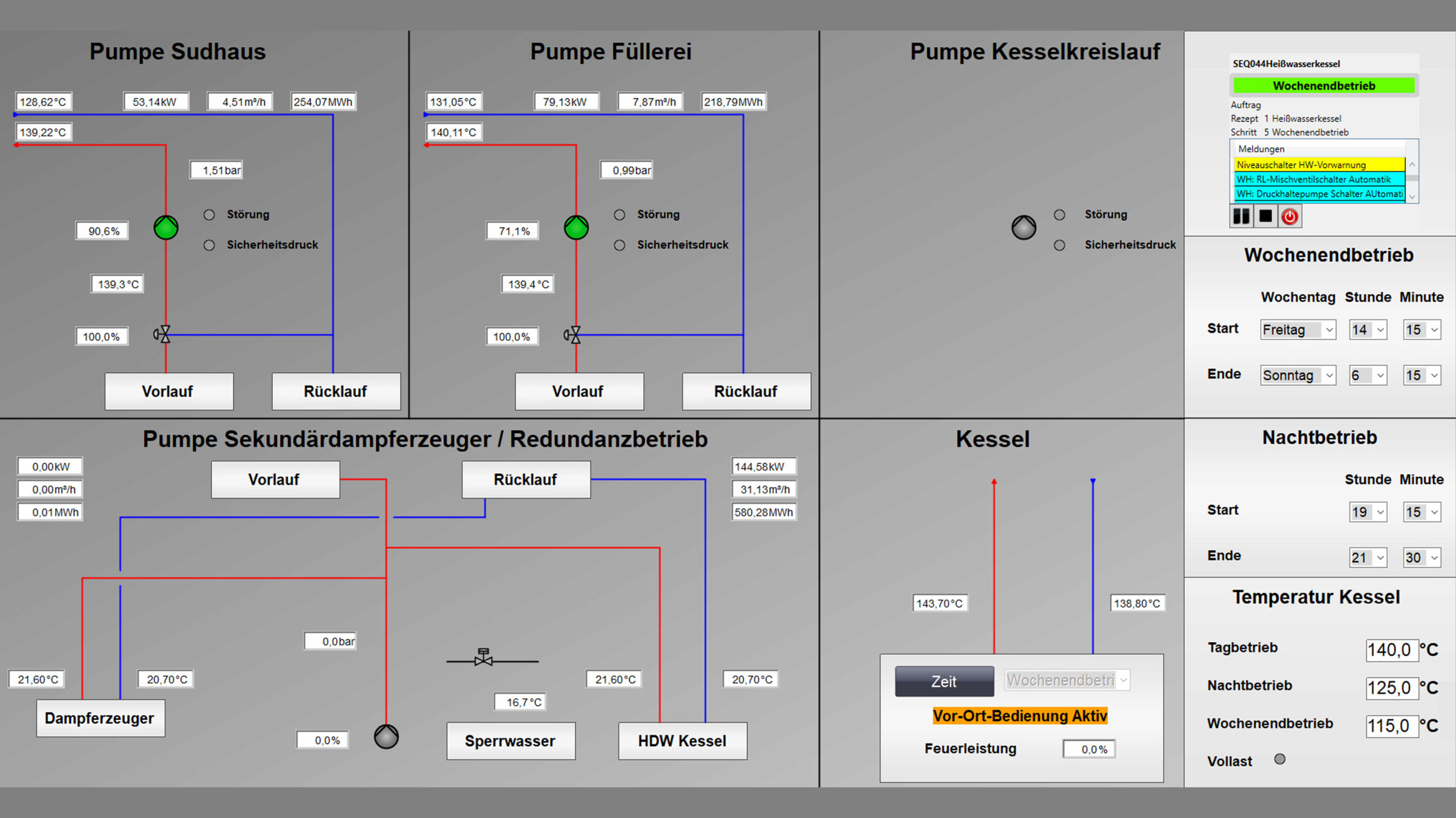
Old vs. new visualization, showing the additional areas “Brewhouse” and “Bottling Plant,” as well as “Steam Generator” and “Circulation Pump.”
A well-designed software solution.
Our program is based on a sequence of steps that concisely represents all possible operating states. The current time is continuously compared with the set time windows so that the program can then jump to the appropriate step. If multiple simultaneous operating states occur, a prioritization takes place in which full-load operation overrides all other operating modes, followed by weekend operation, which in turn takes precedence over night operation. Otherwise, the step sequence remains in normal operation.
To make data management even more user-friendly, we created data modules that, in turn, provide the data for our visualizations. A third module forwards the data we generate to the boiler control systems.
Lean infrastructure
The new infrastructure focuses on identifying the full-load signal, which is transmitted directly from the existing Multibrau control system to our WinCC control system. In addition, in collaboration with the responsible network operators, we had to establish all the prerequisites necessary for a secure connection from our control system to the boiler control systems. Only then could the connections be established and all signals tested.
It was  a particular challenge to create a program that links cycle times while also meeting the requirements of Step7.


Benefits
Focus on PC security
Thanks to our deliberate decision to use the proven SIMATIC high-end IPCs (industrial PCs), we offer our customers the best security standards currently available on the market. This is supported by faster and more secure hardware, as well as software solutions such as firewalls and antivirus programs, and secure remote maintenance via VPN.
Central control
Operators are no longer dependent on the old PCS7 control system and can control the kettle and most of the rest of the brewing process centrally via the WinCC visualization system. In doing so, they benefit from the transition to Siemens WinCC V7.5, along with the areas that have already been converted.
Significant simplification
The compact design of the control system noticeably reduces the workload for operators. The weekly scheduler has been significantly simplified and adapted to the new processes.
automation excellence
Think beyond the scope of the task at hand. It’s worth it.
The logic behind our weekly planner program can be applied in the same or a similar form wherever changes in operating schedules play a role. In doing so, we consistently apply our expertise from the brewing industry to future projects.
Moving on the flight
with absolutely no downtime and minimal coordination required during ongoing operations
Scalability
Economic application to other time-sensitive areas of brewery operations as well
Process expertise
Thanks to our many years of experience and expertise in brewhouse control, we were able to significantly speed up processes and noticeably reduce the workload for our customers.


