


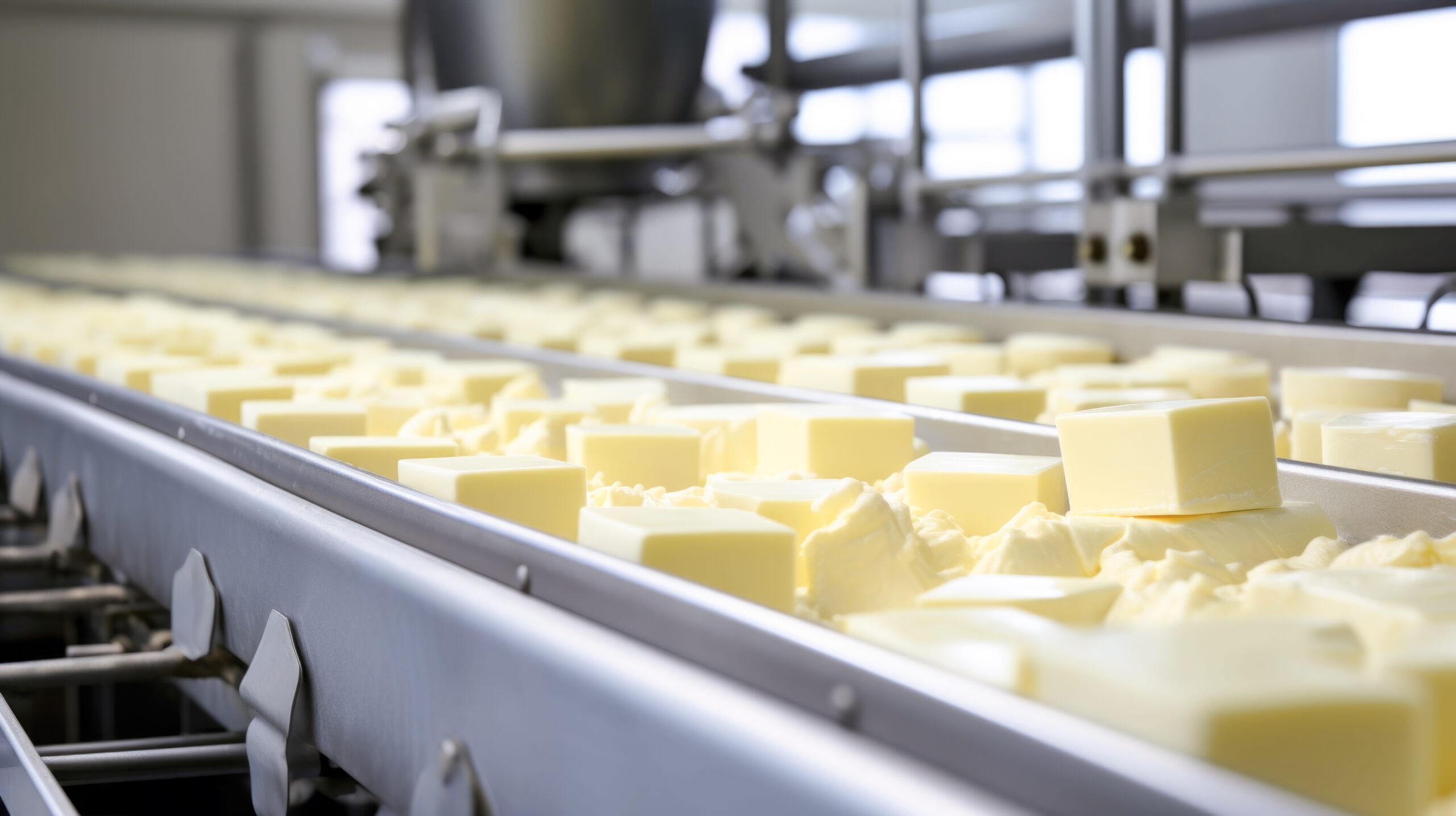
How modernization at the butter plant is shortening cleaning cycles and improving process safety.
These are the well-known efficiency drainers that hinder both the process and output in today’s butter production. Outdated programming and hardware, a lack of automation and documentation, and inefficient cleaning procedures. We were commissioned by a renowned dairy customer to modernize its butter production facility. Together with the equipment manufacturer, we developed a comprehensive, end-to-end solution that restores the butter production line’s competitiveness and efficiency with minimal effort and absolutely no downtime.
Clear objectives for the project
Speeding up the cleaning process
Separating the cleaning of the butter silo and packaging equipment from the butter plant’s CIP system
Modernization of security technology
Minimize downtime
The challenge
Cleaning the butter silo along with the packaging machines (4 units) always had to be paused because these pieces of equipment are almost always cleaned together. As a result, downtime was high, and there was a significant need for optimization. This is where we had to start.
90t
more butter per week
Solution
We cut into the butter from both sides.
Optimized cleaning
The modernization effort is focused on the cleaning process. As part of this, items to be cleaned—such as the butter silo and packaging machines—are first reassigned to other CIP loops that are used less frequently.
Optimized hardware
At the same time, we are optimizing pipeline routing and installing modern safety technology to lock coupling elbows, as well as new valve combinations. In doing so, we are deliberately reducing the number of points where switching is required.
”Our automation saves our customer 3 hours of downtime per cleaning cycle. That amounts to about 9 hours per week, resulting in 90 metric tons more butter production. That’s what we call efficient.
Jens Fiebig
Automation in the process
Extension
Ejection of the butter at the end of production using controlled sterile air, with the clear advantage that the product can still be used without melting
Preheating
Heat the fresh water and run it through the cleaning cycle. Skip the cold-run if the system is still cold after the final rinse.
Emptying the butter silo and the packaging machines
Melting independently of the CIP system, connecting the cleaning process to another CIP system, and adapting the current cleaning programs to the butter plant’s equipment
Level measurement
Integrating a laser level measurement system and programming escalation scenarios for when the level in the butter silo is too low or too high

automation excellence
Efficiency gains throughout the entire cleaning process, without any downtime.
The interfaces for each production unit must be defined and designed individually in advance. As a result, each interface is essentially one-of-a-kind and is fine-tuned in a very short time thanks to our team’s extensive experience and automation expertise. Depending on the production system, communication takes place either cyclically or on an event-driven basis.
Better cleaning of the objects
by increasing the flow rates in the pipes. This allows us to shorten the cleaning time and reduce the consumption of cleaning agents (lye, acid, water)
Greater security
through automatic valves and monitored coupling elbows. Operators must actively acknowledge safety-critical system components after maintenance or cleaning. Enhanced automatic production logging ensures better traceability
Cutting cleaning time in half
in the butter plant by simultaneously cleaning the butter silo and the butter machine
Reduction of downtime
thanks to the new ways the line can be configured. The entire system becomes more flexible and can continue production while individual parts are being serviced


