


Saving Water in the Dairy: Automatically Reusing Residual Water from Heaters and CIP Cleaning.
In a dairy, a large volume of process water flows through the facilities every day without becoming contaminated—and yet it still ends up in the sewer. For a well-known large-scale dairy, we automated a water storage system that collects this water, tests it, and returns it to the process.
When heaters and UHT systems are not in production, they are filled with sterile fresh water. When the product enters the system, the water is displaced—until now, directly into the drain. The cleaning process is similar: Each CIP loop is first pre-rinsed with fresh water. At the end of the cycle, water flushes the cleaning solution out again. A large portion of this water is clean enough to be used for preparing alkali and acid solutions or for pre-rinsing. With the right automation, this waste becomes a resource: the discharge water is detected, collected, and reused without changing production or cleaning recipes.
60
Fully automated stack water system requiring no operator intervention
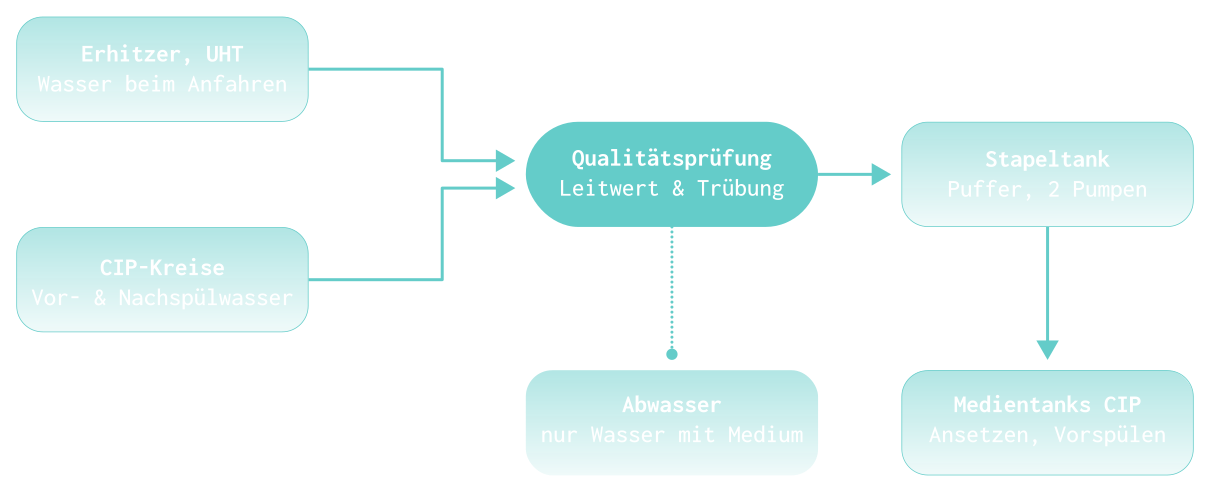
Each connected object is monitored by two conductivity meters. We also check the turbidity in the collection line. The valve to the storage tank opens only if both values are within the specified range. Process water that still contains cleaning agent does not enter the tank; it is discharged into the sewer as before. Everything else is collected.
Collector line with its own step chain:
It communicates with the control system of each water source and accepts water only if the source and water quality are suitable.
Tank track for the stackable tank:
Filling, emptying, or both simultaneously.
Dispensing using two pumps in alternation:
They pump the water to the media tanks of the CIP stations.
Integrated Cleaning:
The pipe and tank of the storage water system are automatically cleaned on a regular basis.
The focus is on the interfaces and communication with each individual system
Heaters discharge water differently. That’s why we examined each source individually. For the cleaning cycles, however, we needed a centralized function that operates the same way at both CIP stations and for all cleaning modes. To ensure that production could continue, the stacked water system was first put into operation independently, and the systems were then connected individually.
Simulate first, then connect system by system
The process of collecting, inspecting, and dispensing runs without operator intervention. Additional system components are being added gradually. Currently, eleven CIP loops from two cleaning stations and seven heaters or UHT units are connected to the system.
”The challenge was to find a solution that would work for both CIPs and, if possible, all cleaning objects—integrated during ongoing operations, with virtually no downtime.
Maximilian KleeProject Planning
The operator can see at a glance which system is currently supplying clean water. Two parameters per source and the turbidity in the collection line determine whether the water goes to the storage tank or the sewer.

The daily counter (black) totals the volume of water dispensed to the CIP media tanks. Each stage corresponds to a dispensing operation. The fill level of the stack tank (orange) indicates that water is being collected and dispensed simultaneously: The water remains in the buffer tank only briefly and is used promptly for preparation and pre-rinsing.

”Anyone who flushes heaters and CIP loops with fresh water ends up paying twice for that water: once when purchasing it and again as wastewater. A gravity-fed water system, on the other hand, returns it to the process.
Jens FiebigProject Manager