


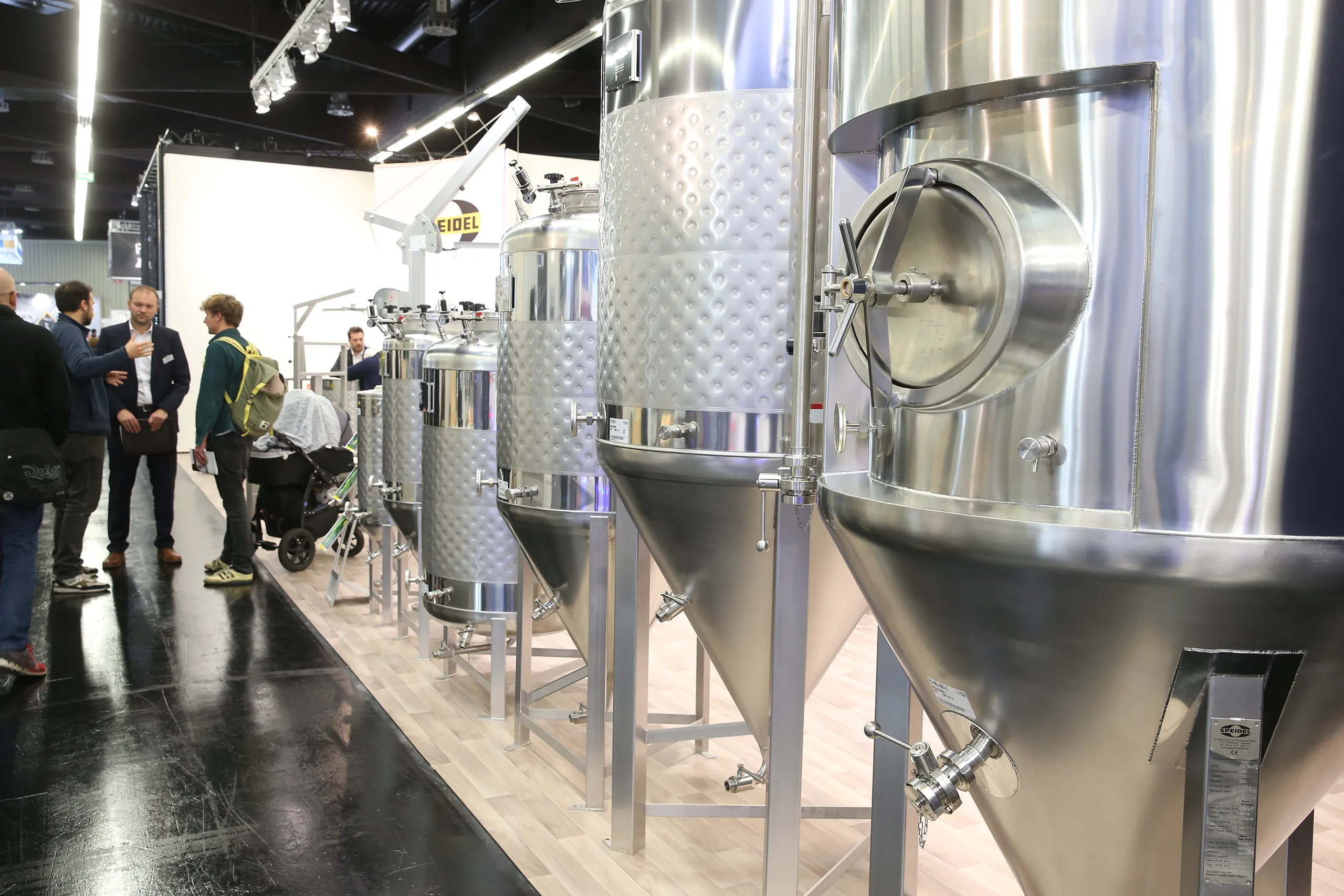
All signs point to automation – Jens Fiebig on brewery trends, challenges, and the upcoming highlights of BrauBeviale 2023.
The transformation has swept through the entire brewing industry, at least since the energy crisis. Digitalization and modernization pose enormous challenges, especially for medium-sized breweries. Where can we use energy even more efficiently, automate processes in a meaningful way, and make production even more economical and sustainable—even for small, high-quality breweries? To get you in the mood for the brewing industry’s most important trade show, BrauBeviale in Nuremberg, we spontaneously invited our brewing expert Jens Fiebig to join us for an automation talk.
Jens Fiebig’s Profile
Project manager and beer lover
Over 20 years of brewery experience
Jens Fiebig is the expert when it comes to automating recipe-driven processes in breweries. Thanks to his exceptional experience and process expertise, this food technologist (who graduated from the Technical University of Munich) supports our customers worldwide on their journey toward efficient and sustainable production.
On a scale of 1 to 10 for automation: How do Germany’s breweries stack up against their international counterparts?
We’re pretty much in the middle of the pack—a solid 5, with a clear upward trend. All the cards are on the table; the small and medium-sized companies, in particular, are catching up. As the number one beer-drinking nation, though, we still have a bit of room to improve (smiling).
Where is there the greatest need for improvement in this country, and what are the biggest challenges?
On the one hand, there’s plant-wide automation; on the other, automated and efficient production planning. Breweries need to improve in these areas because they’re squandering enormous potential. This means enabling cross-level communication and updating outdated components. At first glance, that sounds like a lot of work. However, thanks to state-of-the-art control and process management technology, most of these measures can be implemented without major modifications or downtime.
A plan for the future
Based on a detailed assessment, we can help make your Brewery more efficient, more cost-effective, and of higher quality. A good automation strategy is the key.
What opportunities are there, especially for small, quality-oriented breweries?
In the future, it will be possible to produce high-quality beer fully automatically and efficiently, even in small batches. Automation is no longer just for large-scale operations; it is now also of interest to small and medium-sized Breweries that serve the market with distinctive varieties and unique characteristics. The technology and software make this possible and, as of now, affordable even for beer varieties produced in small batches.c
Everyone is talking about energy savings. How can automation contribute to a brewery’s energy management? What are the key areas to focus on?
To me, it’s clear that this applies to the automated use of production planning and energy supply. Even today, it’s already possible to plan more effectively and with a focus on the future, thereby minimizing consumption.
Through end-to-end automation, equipment in the system—such as a filling machine—can be turned on and off on demand. A steam boiler is thus started up only when it is actually needed, rather than remaining in standby mode all day. I see significant opportunities for savings and energy recovery, particularly in the area of networked plant control and automation, since the plant can be intelligently turned on and off using various algorithms.
In addition, we can integrate production planning into the automation system, distribute energy demand evenly throughout the day, or, if a solar power system is connected, time it to coincide with daylight hours in order to use renewable energy more efficiently.
”As a general rule, wherever automation can save resources, we also reduce our carbon footprint.
Jens FiebigProkurist und Projektleiter
How can automation contribute to the transition to a low-carbon economy?
Through proactive and automated operation of systems and their surroundings, it is possible to reduce energy consumption and, consequently, energy costs. In the area of heat recovery in particular, automation offers a wide range of opportunities to make effective use of available energy and to supply waste heat to other processes. In this way, sustainability can also unlock economic potential that accelerates the transition to a carbon-neutral, self-sufficient Brewery.
What new developments in the field of automation can we look forward to at the trade show?
This is clearly the next generation of Siemens controllers. With the launch of the S7-1500 controller in the process automation sector, breweries stand to benefit from enormous cost and efficiency advantages. For example, the cycle time for monitoring can be accelerated, while replacing a conventional 416 controller can save up to 45% in component costs. The simple integration with the surrounding environment via the controller’s wide range of built-in features also offers the advantage of better networking between plant components.
Another important topic is standard machine interfaces. What’s new here is that every machine manufacturer now offers standard interfaces in its control systems via standardized protocols. This makes integration into the overall plant system straightforward and saves a tremendous amount of time and money during the planning of complete production lines by eliminating the need to clarify interface requirements. In this way, individual machines can be directly integrated into the recording of measurement data and production planning. As a result, responses to events can now take place almost in real time.
Another important topic is standard machine interfaces. What’s new here is that every machine manufacturer now offers standard interfaces in its control systems via standardized protocols. This makes integration into the overall plant system straightforward and saves a tremendous amount of time and money during the planning of complete production lines by eliminating the need to clarify interface requirements. In this way, individual machines can be directly integrated into the recording of measurement data and production planning. As a result, responses to events can now take place almost in real time.
What role will AI play in the brewing process in the future? What are the opportunities, and what are the risks?
First of all, AI could play an important role in the future by automatically responding to changes in the brewing process, capturing the experience of master brewers, and, to a certain extent, replacing it. However, this also increases the risk of losing human experience. Here, opportunities and risks must always be scrutinized and weighed against one another, especially in food production.
Digital transformation is all about data transparency and availability. How can needs-based automation be a game-changer in this context?
A transparent process that reliably records all process parameters can be designed to respond quickly to changes in the workflow. This ensures products of consistent quality. Added to this is the increasingly important issue of traceability—that is, the end customer wants to see where their product comes from at the push of a button. This can only be achieved transparently and efficiently through end-to-end automation.
Any questions?
Then why not stop by our booth from November 28–30 in Nuremberg?
We look forward to seeing you there!
Nuremberg Trade Fair
Hall 7
Booth 7-320


